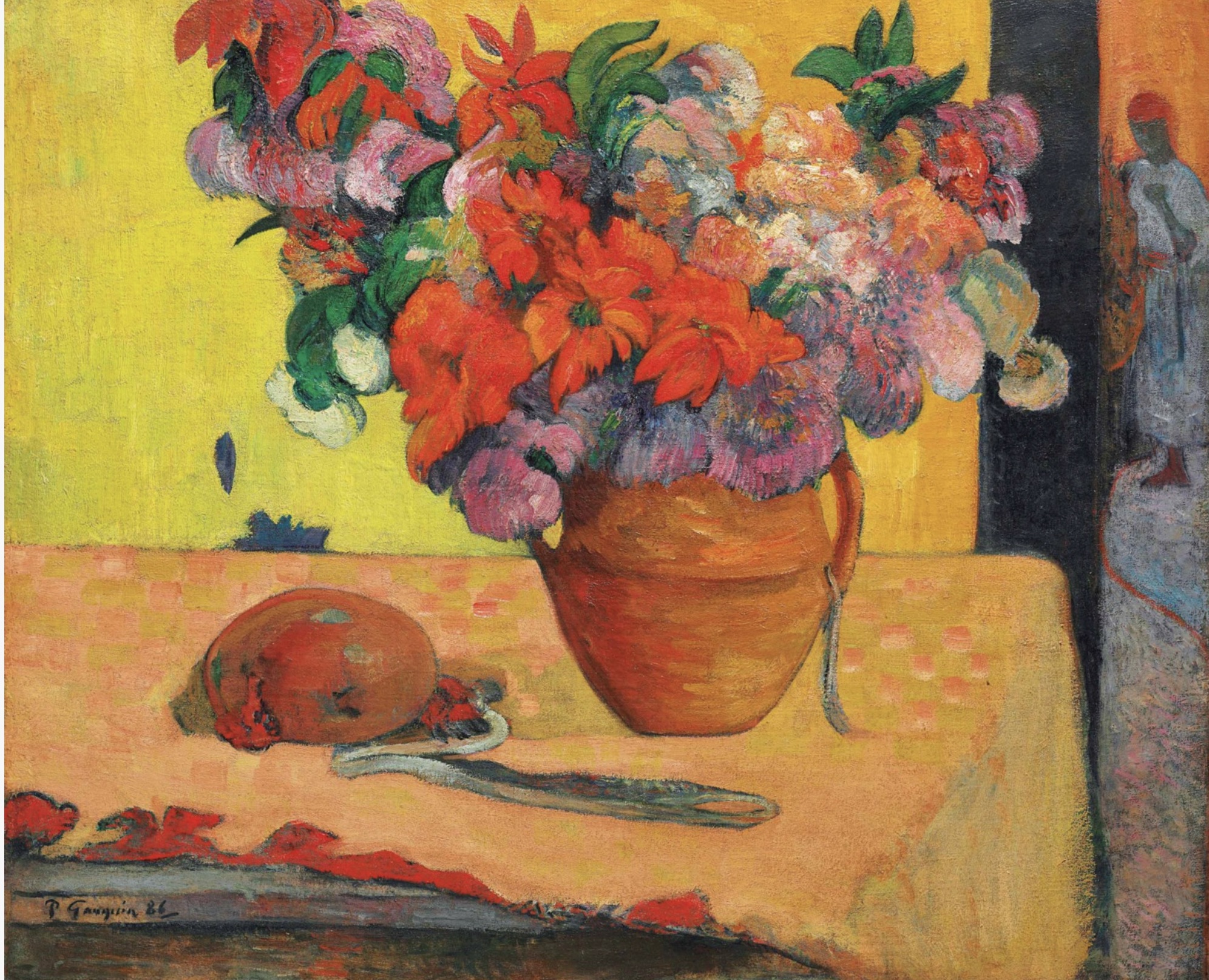
“In its final form, the painting is a private palimpsest of the various phases of Gauguin’s evolution as a painter, documenting—to paraphrase the title of the artist’s later Tahitian masterpiece—where he had come from (“d’où venons nous”), who he was (“que sommes nous”), and where he was going (“où allons nous”). “Tracing the trajectory of Gauguin’s artistic development after 1886, this painting demonstrates his enduring ties to European art, while underscoring his urgent need to connect with something completely foreign,” Ann Temkin has written. “The final painting’s palette and iconography are the result of the artist’s trips to Martinique and Tahiti in search of what he imagined to be a pure, primitive art. In the process of transforming the work, Gauguin self-consciously translated his still life, a genre born of European tradition, into a new visual language of vibrant hues and unfamiliar subjects” (G. Lowry, intro., op. cit., 2015, pp. 39-40).”
READ FULL ESSAY: Christie’s
Hear More
See More
Tag: Paul Gauguin At Sunnyside
Paul Gauguin at Van Gogh Museum
Read More
Thanks for Visiting 🙂
~Sunnyside
 At Sunnyside - Where Truth and Beauty Meet
🧡
LikeLiked by 1 person
Magnificent Gauguin…
LikeLiked by 1 person
There’s no composer more joyous than Vivaldi when he sets his mind to it ~ and the flowers are perfect for it!
LikeLiked by 1 person
Truly, I don’t know anyone could listen to Vivaldi and not feel better. Joyous is a great description, Ana. 🙂🌺
LikeLiked by 1 person
“Spring!”
LikeLiked by 1 person
Yes! Here is my favorite version so far: https://atsunnyside.blog/2021/04/07/vivaldi-la-primivera-spring/
LikeLiked by 1 person
I’m still obeying asanas prohibiting broadcast works ~ but I’m sharing it with you in my mind!
LikeLiked by 1 person
👍👍😎
LikeLiked by 1 person
What a lovely note to finish my day – with a Gauguin image. Thank you:)
LikeLiked by 1 person
My pleasure, always, Janet. 🙂🌺
LikeLiked by 1 person