
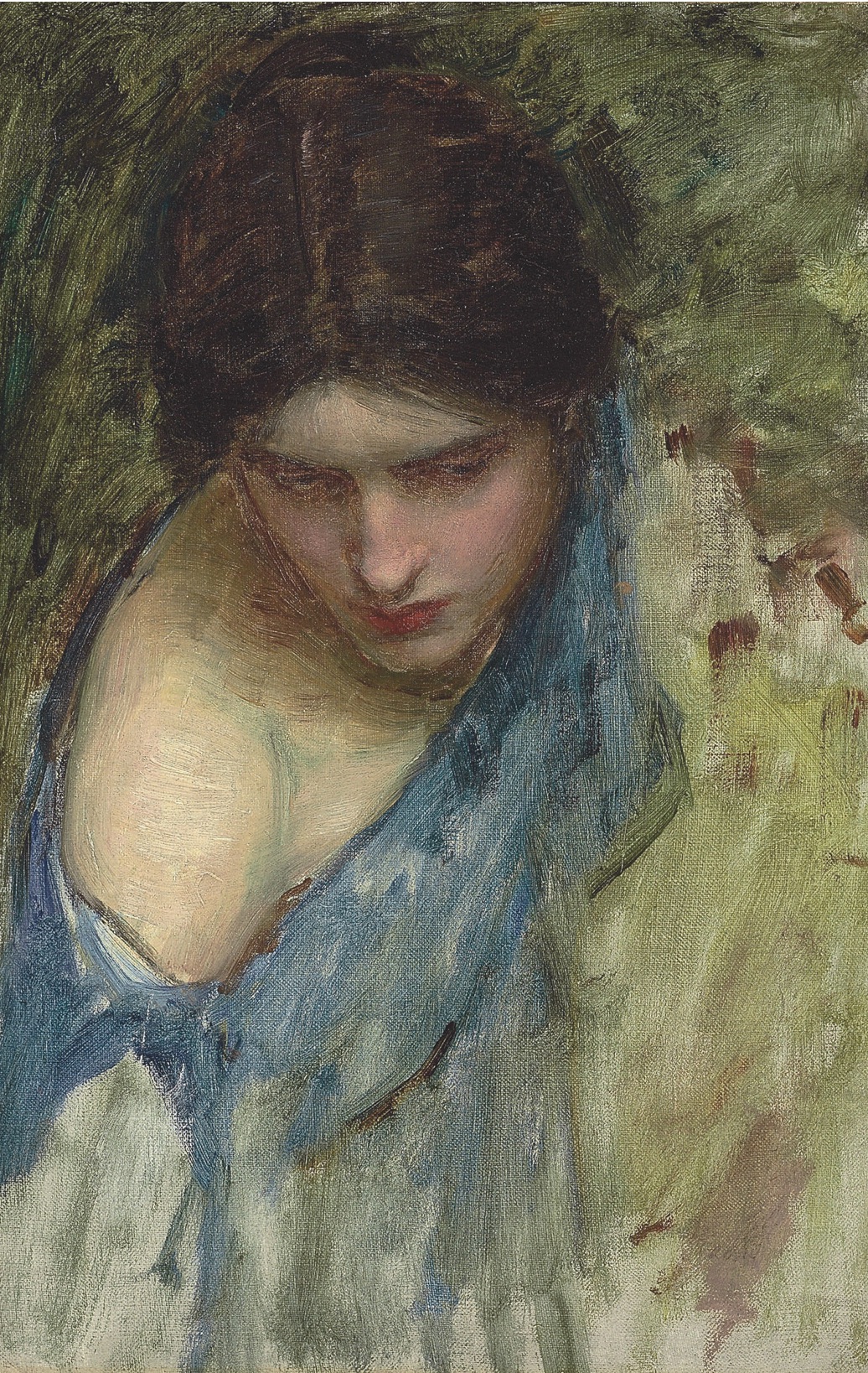
“The depiction of this mythic moment is unique within Victorian painting, and possibly within all of British art. Through the late 19th Century, Symbolist artists and writers had grown evermore enthusiastic about Orpheus, the greatest poet and musician in Greek myth, because he, like so many creative individuals, sang the truth and thus aroused resentment. Dismissed by his contemporaries as effeminate for mourning his wife too passionately, Orpheus was torn to pieces by Maenads after rejecting their advances. Into the river they hurled his head, which demonstrated art’s immortality by continuing to sing as it floated away…
The present sketch deftly conveys the girl’s mix of alarm and sympathy: her eyes gaze downward, drawing her head and upper torso forward without seeming ungainly. This work also reveals how Waterhouse built up his surface, focusing most intensively on the flushed face, then on the hair and other flesh passages. (Particularly adept is the shadowing along and below the right cheek, which allows the brighter nose and shoulder cap to guide our eyes downward.) Highly characteristic are the delicate blue colouring of the garment and the lively brushstrokes in the background, especially the dark dabs at right centre that hint at the right-hand nymph”.
READ FULL ESSAY: Christie’s
See More
John William Waterhouse At Sunnyside
John William Waterhouse at Christie’s
John William Waterhouse at wikimedia commons
Read More
John William Waterhouse at wikiwand
Thanks for Visiting 🌻
~Sunnyside
 At Sunnyside - Where Truth and Beauty Meet