
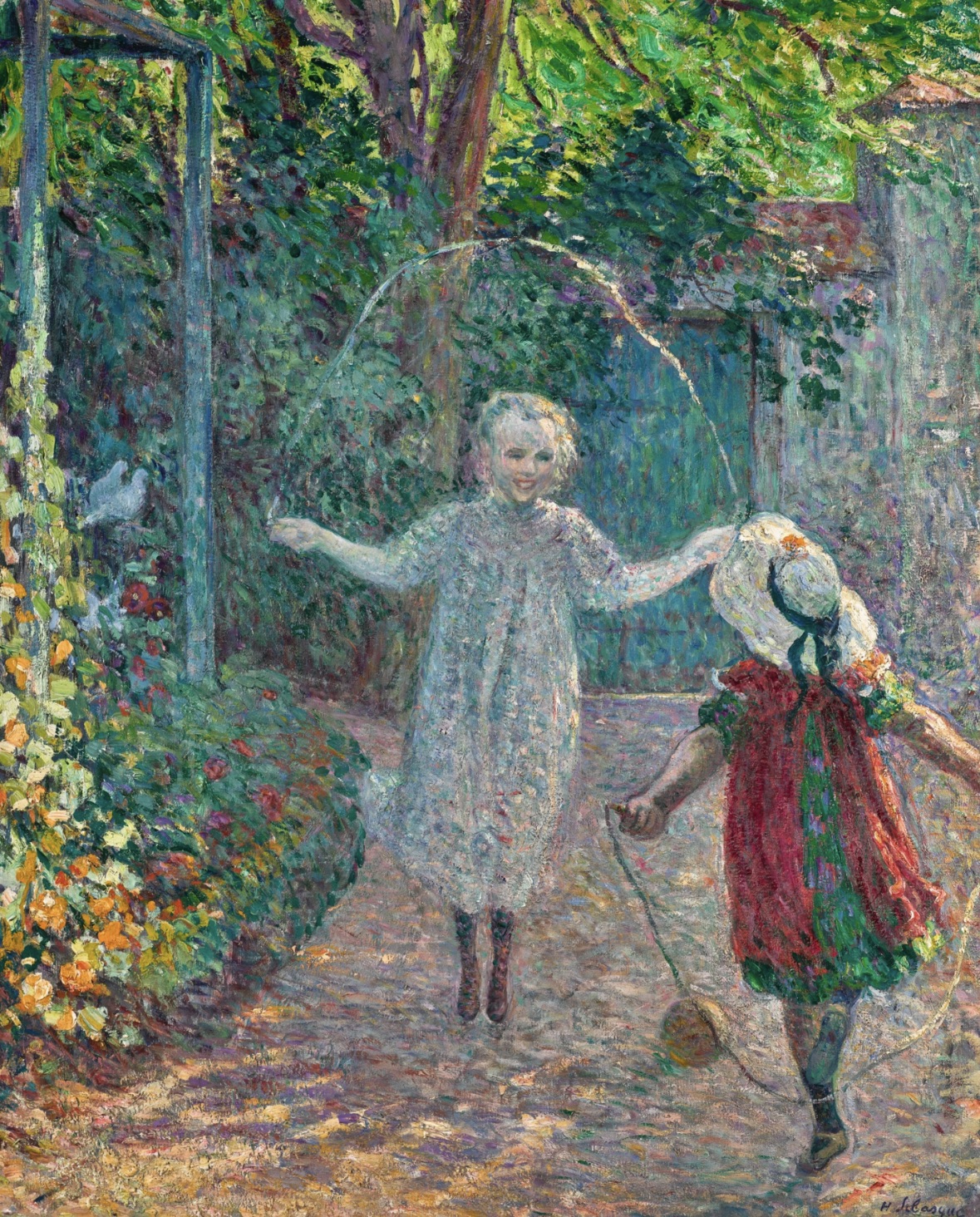
As is noted by Lisa Banner, ‘’Intimism,’ a term which best describes Lebasque’s painting, refers to the close domestic subject matter in such a manner as to convey the personal nature of his response to the thing painted, and the universal familiarity of home and family. There is a sense of calm infused in Lebasque’s paintings which celebrate the fullness and richness of life. In his placid scenes of gardens and beaches, terraces and dinner tables, Lebasque portrays his family in particular, but in such a way that he appeals to a larger sense of family gathering and devotion’ (Lisa A. Banner & Peter M. Fairbanks, Lebasque, 1865-1937, San Francisco, 1986, p. 12). Fillettes sautant à la corde captures this sentiment, both through the positioning of the children who, framed by the arcs of their skipping ropes and immersed in their game, are turned towards one another, and via the light brushstrokes which recall the work of Camille Pissarro under whom Lebasque studied upon his arrival in Paris in 1885. The period which followed was one of keen experimentation for Lebasque, in particular in his depictions of light and shadow. Lebasque’s confident casting of his subjects in the dappled shadow of the tree reflects this artistic growth and the palette of rich pink and blue tones that imbue the work with a sense of grounding and peace are a fitting testament to the placid nature of the artist who, as his daughter Marthe fondly recalls, ‘was content in the midst of his family’ (op. cit., p. 113).
READ FULL ESSAY: Sotheby’s
Hear More
Read More
See More
Thanks for Visiting 🌻
~Sunnyside
 At Sunnyside - Where Truth and Beauty Meet