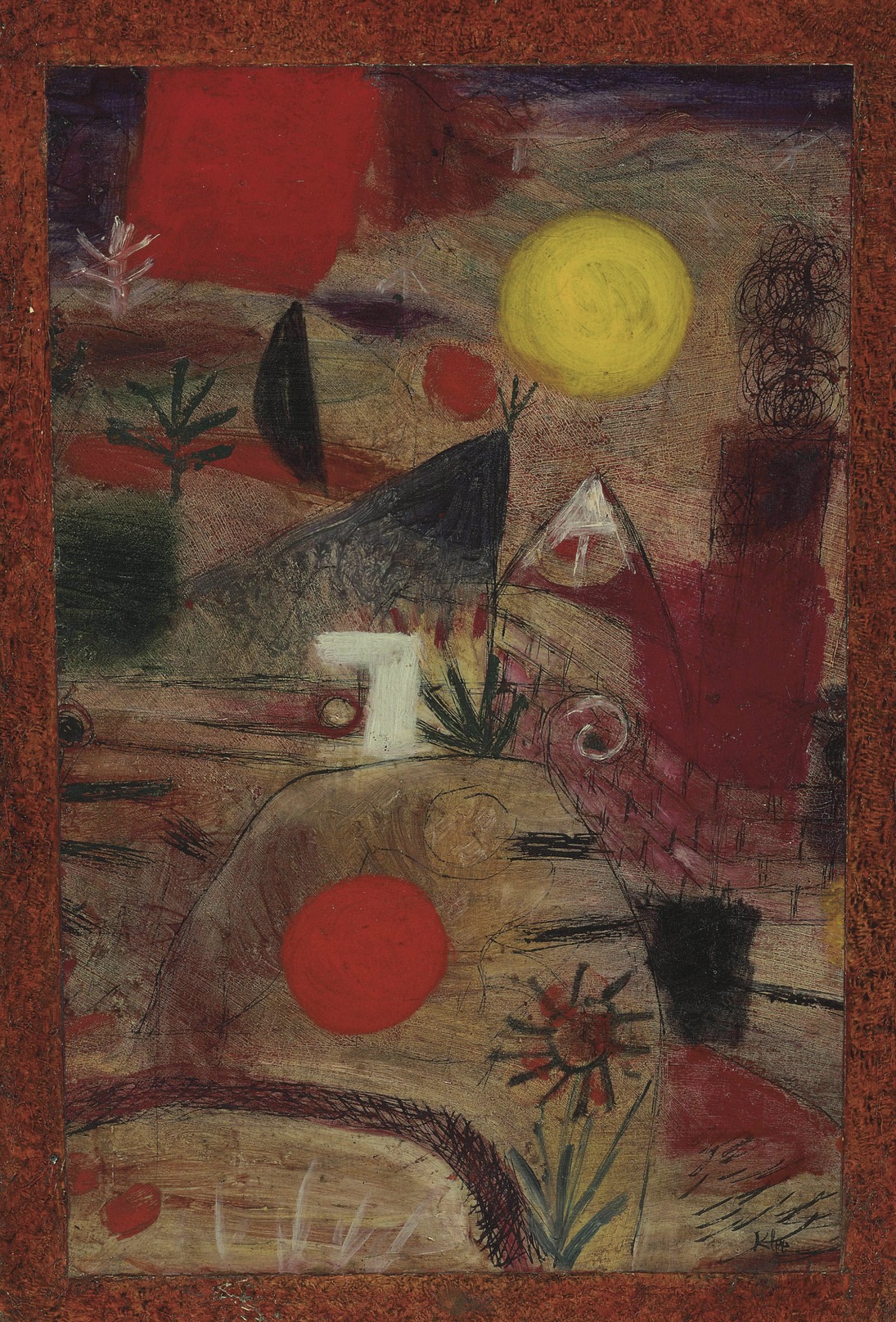
“The present painting is part of a group of rhythmic, wooded landscapes that Klee made in 1920, the year after he first began working in oil….The dominant red and brown tonalities reflect the colors of the fall foliage, while the title of the painting–Feier und Untergang (Celebration and Decline)–evokes the bounty of the harvest followed by the advent of winter. Blocks of flat color, familiar from the Orphist elements in Klee’s pre-war work, serve as a unifying structure for the linear forms that comprise the landscape. …Klee was extremely sensitive to the timbre of various landscapes, and his diary repeatedly documents his response to the terrain; he also had assembled a diverse collection of botanical materials that he studied as a repertoire of forms. His goal, however, was not the mimetic translation of observed forms into art, but rather an analogy between nature and the artist’s creative work, which in his view were subject to the same laws. He declared in Creative Credo, “Art is a likeness of the Creation. It is sometimes an example, just as the terrestrial is an example of the cosmic” (quoted in ibid., p. 181).”
READ FULL ESSAY: Christie’s
See More
Read More
Paul Klee Notebooks at wikiwand
3,900 Pages From Paul Klee’s Personal Notebooks Are Now Online
The Diaries of Paul Klee – Part One (- of Seven!): a Publishing Success, by Francesco Mazzaferr
Thanks for Visiting 🌻
~Sunnyside
 At Sunnyside - Where Truth and Beauty Meet
One of my top favorite artists of all time.
LikeLiked by 1 person
I can understand why, Michael. Thanks for sharing your thoughts. 😊
LikeLiked by 1 person
You’re most welcome.
LikeLiked by 1 person