
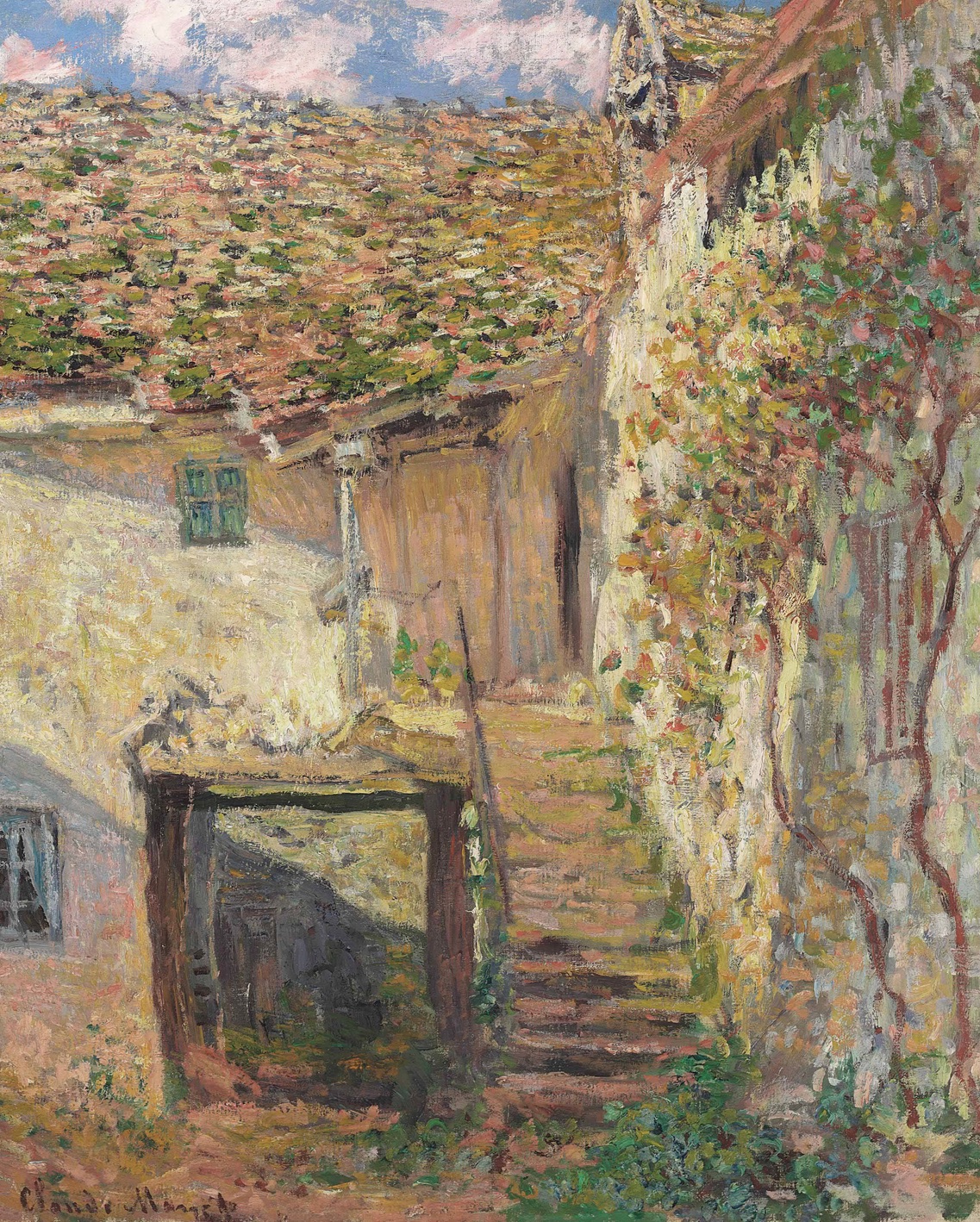
“In L’Escalier, Monet has selected as his subject an unprepossessing but utterly charming corner of an old farmyard. The pale stucco walls and steeply slanting, shingled roofs form a shallow succession of jostling planes, with only a narrow strip of cloud-flecked sky visible at the top of the canvas. In compositional terms, L’Escalier is anchored around a narrow set of stairs that leads the viewer’s eye into the scene, a device that Monet would reprise three years later in his celebrated views of Jean and Michel in the garden of the family’s home at Vétheuil (fig. 4). The subtle but richly nuanced palette of L’Escalier is dominated by yellow, ochre, and sepia tones, which suffuse the scene in a warm, autumnal glow. Weathered buildings and fall foliage alike are painted with the same golden hues and active, flickering touch, suggesting that the work of man and that of nature–rather than being at odds, as Monet had come to find them at Argenteuil–are harmoniously and inextricably linked in this rustic, peaceful milieu.”
READ FULL ESSAY: Christie’s
See More
Monet’s Water Lilies At Sunnyside
Claude Monet at Kunsthaus Zurich
Claude Monet at National Gallery of Art
Claude Monet at Art Institute of Chicago
Claude Monet at Philidelphia Museum of Art
Claude Monet at Musée Marmottan Monet, Paris
List of Paintings by Claude Monet at wikiwand
Works by Claude Monet at Museum Barberini
Claude Monet at Museum of Fine Arts, Boston
Claude Monet’s Bordighera Series in Museum Collections (links at bottom)
Read More
The Impressionist Spirit essay
Claude Monet on The Metropolitan Museum of Art’s Heilbrunn Timeline of Art History
Thanks for Visiting 🌻
~Sunnyside
 At Sunnyside - Where Truth and Beauty Meet