
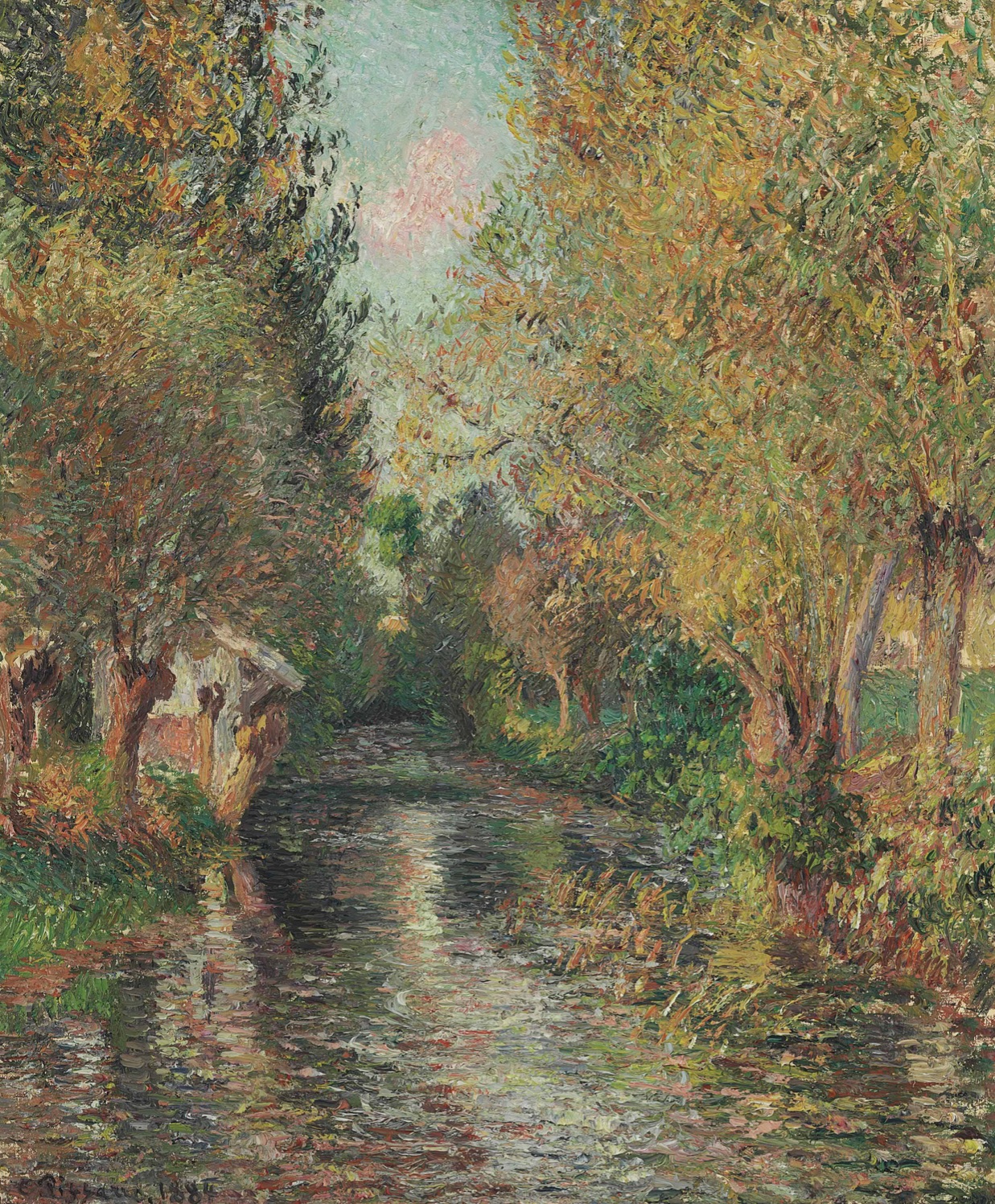
“Pissarro painted the present scene during the early fall of 1884, when some of the trees retained their green and others were ablaze in red, orange, and gold…The canvas depicts a small wash-house on the banks of the Epte at Bazincourt, where local women could launder their clothes…Unlike Pissarro’s well-known view of the wash-house at Port-Marly from 1872, which focuses on the economic life of a bustling stretch of the Seine, Le lavoir de Bazincourt is a scene of utter tranquility (Pissarro and Durand-Ruel Snollaerts, no. 229; Musée d’Orsay, Paris). The wash-house is tucked inconspicuously behind the trees, and almost the whole canvas is given over to the profusion of multi-hued foliage and its reflection in the gently rippling surface of the river below. Although Pissarro’s attention to the play of light over the tranquil landscape is quintessentially Impressionist, he has forsaken the free, painterly handling of the Impressionist plein-air sketch in favor of uniformly small, evenly distributed, and carefully controlled touches of pigment, paving the way for his enthusiastic embrace of Neo-Impressionism the very next year.”
READ FULL ESSAY: Christie’s
See More
Camille Pissarro at Christie’s
Read More
Thanks for Visiting 🌻
~Sunnyside
 At Sunnyside - Where Truth and Beauty Meet