A sale catalogue in 1898 described the dancer pictured in Edgar Degas’ pastel, The Singer in Green: “Skinny and with the graceful moves of a little monkey, she has just sung her ribald verses and, with a gesture that conceals an entreaty behind her smile, is inviting applause.” With her small eyes, high cheeks, and…
Category: French art
Ivo Pogorelich: Für Elise
“Renoir made several paintings of spectators at theaters or concerts—a subject that explores the theme of seeing and being seen. Although the artist may have begun the painting as a portrait of specific individuals, he later reworked it to present two women whose identities and relationship are unknown. The subdued lighting and clearly defined forms…
Edmond Aman-Jean: Femme à la fleur
Read More Edmond Aman-Jean at wikiwand See More Edmond Aman-Jean at Art Renewal Center Edmond Aman-Jean at wikimedia commons Thanks for Visiting 🙂 ~Sunnyside
Edgar Degas: The Ballet Class (1871-1874)
“Compared to the other Impressionists, Edgar Degas was more of a traditionalist. The Frenchman didn’t paint en plein air, his color palette was subdued for much of his career and his spontaneity was painstakingly rehearsed. With a fascination for human anatomy reminiscent of Leonardo da Vinci, he would do countless studies for one single painting….
Telemann: Fliehet hin, ihr bösen Tage
TRANSLATION: Fly away, evil days of my life, fly away! Constant suffering has left me less than half alive. Bitters and affliction have been my drink and daily bread. My time has been spent in groans, signs and wringing my hands. Jeffrey Stivers Thanks for Visiting 🙂 ~Sunnyside
Odilon Redon: Ophelia Among the Flowers
“The painting illustrates a particular moment in the play, in which Ophelia finds her way to the brook, where she meets her end amongst the flowers that she has gathered. This moment, though frequently figured as a descent into madness, can also be interpreted as an escape from the patriarchal dominance that has moulded her…
Odilon Redon: Bouquet of Flowers (c.1900-1905)
“As a young man, Redon was fascinated with Darwinian biology and enjoyed a close friendship with Armand Clavaud, the curator of the botanical gardens in his hometown of Bordeaux. In late floral still lifes such as this one, the artist demonstrated a naturalist’s sense of wonder as well as a richly inventive imagination, combining many…
Henri Lebasque: Marthe et Pierre Lebasque dans un intérieur, (1913-14)
Painter of ‘Joy and Light’ Painted in 1913-1914, Marthe et Pierre Lebasque dans un intérieur by Henri Lebasque continues his theme of painting interiors, often including his own family members. This painting depicts Lebasque’s children Marthe and Pierre. As Lisa Banner observes, ‘Intimism, a term which best describes Lebasque’s painting, refers to the close domestic subject…
Jean-Honoré Fragonard: Young Girl Reading
‘A Young Girl Reading’ The Rococo painting by French artist Jean-Honoré Fragonard (c.1770) features an unidentified young woman wearing a rich, saffron-yellow dress with glowing, white ruff, collar, and cuffs; lavender ribbons accent her bodice, neck and hair. Shown in profile, she is reading from a small book with reddish gilt edging held in her…
Pierre Bonnard: Portrait de Madame Hessel ou La Dame en Rouge (1901)
Lucy Hessel is shown here in an interior scene, seated in a chair, her left arm resting on the chair back, which shifts her entire body and confers a detached attitude with a certain self-assurance, leaving us to imagine that she is fixedly gazing at someone outside of the frame and with whom she is…
Edgar Degas: Two Dancers, (1893-1898)
Thanks for Visiting 🙂 ~Sunnyside
Odilon Redon: Flower Clouds (c.1903)
The evocative, symbolic art of Odilon Redon drew its inspiration from the internal world of his imagination. For years this student of Rodolphe Bresdin worked only in black and white, producing powerful and haunting charcoal drawings, lithographs, and etchings. Just as these black works, or Noirs, began to receive critical and public acclaim in the…
Renoir: The Umbrellas
“Painted in two stages, with a gap of around four years between each stage, it shows the change in Renoir’s art during the 1880s, when he was beginning to move away from Impressionism and looking instead to classical art. The group on the right, which includes a mother and her two daughters and the woman…
Albert Aublet: Reading on the Garden Path (1883)
Click for Enlarged Detail Slideshow best viewed At Sunnyside Read More Albert Aublet at wikiwand See More Albert Aublet at Wikimedia Commons Thanks for visiting 🙂 ~Sunnyside
Pierre Bonnard: Paysage stylisé, Le Grand-Lemps
“Like many of the young artists who were affiliated with the modernist avant-garde on the cusp of the 20th century, Bonnard was a quick and early starter, and he made some remarkable pictures before he was only twenty-five. Executed circa 1890, Paysage stylisé (Le Grand-Lemps) represents the cutting-edge style of a new anti-naturalist tendency in…
Albert Aublet: L’heure de Bain au Tréport (1885)
Click For Enlarged Detail Slideshow best viewed At Sunnyside Thanks for Visiting 🙂 ~Sunnyside
Piatti: Complete Cello Sonatas
A capacious library of Baroque-era works bears the name of the Italian cellist Alfredo Piatti (1822-1901) as an assiduous and pioneering editor, arranger and promoter of music for his instrument. Much less familiar are Piatti’s own original pieces. This is the first modern recording and the only available collection on record of all six sonatas…
LÉO GAUSSON: Paysage aux environs de Lagny, l’église de Conches (1887)
Léo Gausson (14 February 1860 – 27 October 1944) was a French landscape painter in the Neo-impressionist and Synthetic styles. He was also a printmaker and sculptor.[1] Click for Enlarged Image Slideshow best viewed At Sunnyside See More Léo Gausson at wikimedia commons Read More Léo Gausson at wikiwand Thanks for Visiting 🙂 ~Sunnyside
Renoir: Portrait of Madame Renoir
“During the early 1870s, Renoir and Monet often painted side by side, producing images of the same subject and sometimes using each other—and other family members—as models. In Renoir’s informal portrait of Camille Monet, the painter’s wife sits on a comfortable sofa reading a paperback book. Small touches of color cover the canvas like stitches…
Georges Braque: L’église de Carrières-Saint-Denis (1909)
The Birth of Cubism Painted in 1909, L’église de Carrières-Saint-Denis dates from the early moments of Cubism. It is in the late landscapes of Braque’s transitional period that the bare bones of the movement truly consolidated. Now, he had advanced on Cézanne in rendering form in two dimensions, and he needed only his return to…
Mendelssohn: Piano Quartet in D minor (1821)
Thanks for Visiting 🙂 ~Sunnyside
Renoir: Woman With a Cat (c.1875)
Click for Enlarged Detail slideshow best viewed At Sunnyside Hat Tip Art and Artists, Cats in Art part 2 Thanks for Visiting 🙂 ~Sunnyside
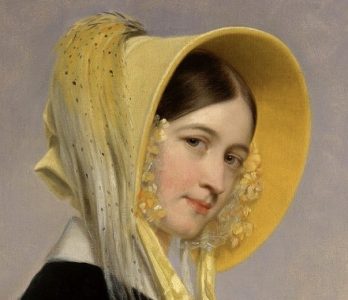
Odilon Redon: La Voile Jaune
Odilon Redon was a French symbolist painter, printmaker, draughtsman and pastellist.
Known for his unique blend of artistic naturalism and symbolic subject matter, Odilon Redon was highly influential among the late 19th century French avant-garde circle. Working in charcoal, pastel, oil, and lithography, Redon created …
James Tissot: Chrysanthemums
The woman in Chrysanthemums is almost overwhelmed by the brilliant blooms surrounding her. She has rolled up her sleeves to adjust a pot, her blurred features suggesting we have caught a glimpse of her in motion. Tissot staged this scene in the conservatory attached to his studio, a glass panel of which is visible in the…
Odilon Redon: Etruscan Vase With Flowers
Odilon Redon’s Originality “Etruscan Vase With Flowers”, like so many of Redon’s other works, feels and looks like another world. Though there is nothing unconventional about the subject matter itself, he paints flowers that do not exist in nature with colors that are unexpected. The result is an extraordinary and original artwork. The Metropolitan Museum…
Louise Farrenc: Trio for flute, cello and piano Op. 45
Trio in E minor, Op. 45 (1854-56) Thanks for Visiting 🌻 ~Sunnyside
A.E. Houseman: How Clear, How Lovely Bright
How Clear, How Lovely Bright – A.E. Houseman How clear, how lovely bright, How beautiful to sight Those beams of morning play; How heaven laughs out with glee Where, like a bird set free, Up from the eastern sea Soars the delightful day. To-day I shall be strong, No more shall yield to wrong, Shall…
Thomas Hardy: The Darkling Thrush
The Darkling Thrush by Thomas Hardy I leant upon a coppice gate When Frost was spectre-grey, And Winter’s dregs made desolate The weakening eye of day. The tangled bine-stems scored the sky Like strings of broken lyres, And all mankind that haunted nigh Had sought their household fires. The land’s sharp features seemed to be…
Camille Pissarro: The Boulevard Monmartre on a Winter Morning (1897)
After spending six years in rural Éragny, Pissarro returned to Paris, where he painted several series of the grands boulevards. Surveying the view from his lodgings at the Grand Hôtel de Russie in early 1897, Pissarro marveled that he could “see down the whole length of the boulevards” with “almost a bird’s-eye view of carriages,…
Gustave Caillebotte: Le Pont de l’Europe, esquisse (1876)
The painting depicts one of the engineering marvels of Caillebotte’s day, an immense bridge spanning the rail yards of the Gare Saint-Lazare. Two men gaze through the massive iron trellises of the bridge toward the depot, the roof of which is glimpsed between the X-shaped girders at the right. Rather than cloaking the latticework of…
 At Sunnyside - Where Truth and Beauty Meet